
Real-Time Fleet Management & Analytics
January 31, 2026
Fuel prices stay volatile, sustainability requirements keep tightening, and fleets are expected to deliver consistent performance with fragmented data and complex operating conditions. Many fleet managers still rely on delayed reports, siloed systems, and manual analysis to piece together what is happening.
Real-time fleet management changes this. By continuously collecting and analyzing vessel data (speed, engine load, fuel-related operational signals, routing, environmental conditions, and operational behavior) modern platforms give shore teams and crews a shared, up-to-date picture of fleet performance.
Instead of reacting after a voyage is complete, operators can detect inefficiencies as they occur, make informed adjustments to speed or power settings in real time, and benchmark performance across vessels.
Why Real-Time Visibility Is the Fastest Path to Fleet Efficiency
For many maritime operations, the biggest barrier to efficiency is not the vessel itself, it is the lack of timely, consolidated information.
Fleet managers often work with delayed logs, inconsistent data formats, or vessel systems that do not communicate with one another. Without a real-time view, identifying where fuel is being wasted, which vessels are drifting from optimal operating profiles, or how weather and routing are affecting performance becomes difficult and time-consuming.
Real-time visibility changes this fundamentally. When speed, engine load, power usage, fuel consumption, and environmental factors are captured continuously and presented in a centralized dashboard, decisions become faster and more accurate.
Fleet teams can immediately see when a vessel is operating above its optimal speed curve, when fuel consumption spikes unexpectedly, or when changing conditions require route or timing adjustments. This leads directly to lower operational costs and more precise control over CO₂ emissions.
Centralized analytics also help align crews and shoreside teams. Instead of relying on manual interpretation or after-the-fact reporting, everyone works from the same live operational data. Patterns become clear, inefficiencies are easier to address, and small changes in vessel behavior translate into measurable fleet-wide savings.
This is where iHelm serves as a real-time performance visibility and decision-support hub. By analyzing vessel signals, maintaining a continuously updated operational model, and providing real-time recommendations, iHelm supports operators in making informed decisions across the entire fleet.
What is AI-based fleet management?
AI-based fleet management is the shift from fragmented, vessel-by-vessel oversight to a unified operational layer built on continuous data collection, centralized analysis, and real-time decision support.
Instead of relying on delayed logs or manual calculations, an AI-supported system gathers live information from across the fleet, GPS, engine signals, speed, power load, weather conditions, and operational behavior and organizes it into a clear, actionable view.
The goal is not to automate navigation or replace the operator. AI in maritime applications serves a different purpose: it analyzes patterns, learns vessel behavior, and recommends actions that support efficiency, safety, and compliance. Captains and fleet managers remain fully in control, but they gain a decision-support system that instantly identifies inefficiencies, highlights opportunities to save fuel, and flags deviations before they become costly.
Centralizing data also eliminates the limitations of siloed vessel systems. Rather than juggling multiple dashboards with mismatched metrics, fleet teams work from a unified platform where fuel use, speed profiles, power trends, and emissions intensity can be compared across the entire fleet.
This makes it easier to benchmark vessels, detect outliers, and prioritize interventions that deliver the highest operational impact.
Cetasol’s iHelm takes this approach further through Adaptive AI, which continuously interprets patterns in how each vessel behaves, not just how it was designed to behave. As data flows in, iHelm maintains a data-driven operational model of the vessel and uses this reference to support insights around speed, power distribution, and operational profiles.
It helps crews make more informed day-to-day decisions and gives shore teams deeper insight into long-term fleet-wide trends.
AI-based fleet management ultimately provides:
- Better route and speed decisions based on real-time conditions
- Earlier detection of inefficiencies or developing maintenance issues
- More consistent compliance reporting
- Lower fuel consumption and reduced CO₂ emissions
- Cross-vessel insights that turn data into coordinated action
By consolidating data and enhancing decision-making, AI-supported systems like iHelm create a more efficient, predictable, and sustainable fleet, without removing human judgment from the loop.
What Real-Time Monitoring Looks Like in Practice
Real-time monitoring reshapes how maritime teams work by shifting the focus from collecting data after the fact to acting on data as it happens. Traditional practices, like noon reports, manual logs, and delayed voyage summaries, provide useful historical context, but offer little support when crews must make split-second decisions in congested waterways, changing weather, or dynamic regulatory environments. Modern fleets now require continuous visibility, not retrospective insight.
Below is what real-time fleet monitoring looks like when it’s fully deployed in daily operations.
Continuous Data Flow From Engines, GPS, and Vessel Signals
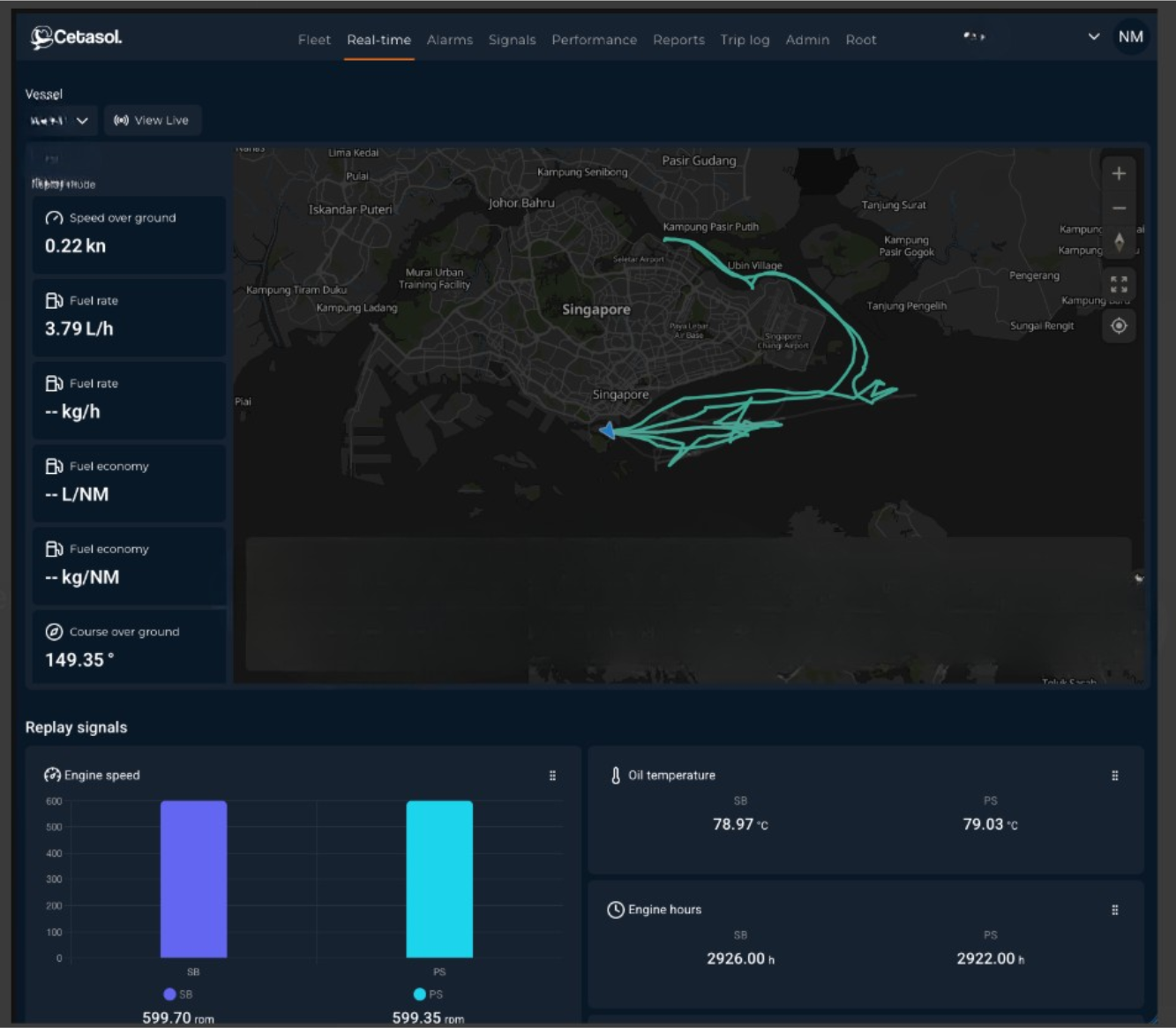
Real-time monitoring begins with uninterrupted data collection. Systems like iHelm ingest engine signals, GPS data, speed, power load, and other available vessel parameters.
This constant flow ensures that the vessel’s operational model is always up to date, reflecting real-world conditions, not assumptions or delayed reports. The result is a highly accurate, continuously refreshed insight of vessel behavior.
Live Dashboards for Crews on the Bridge
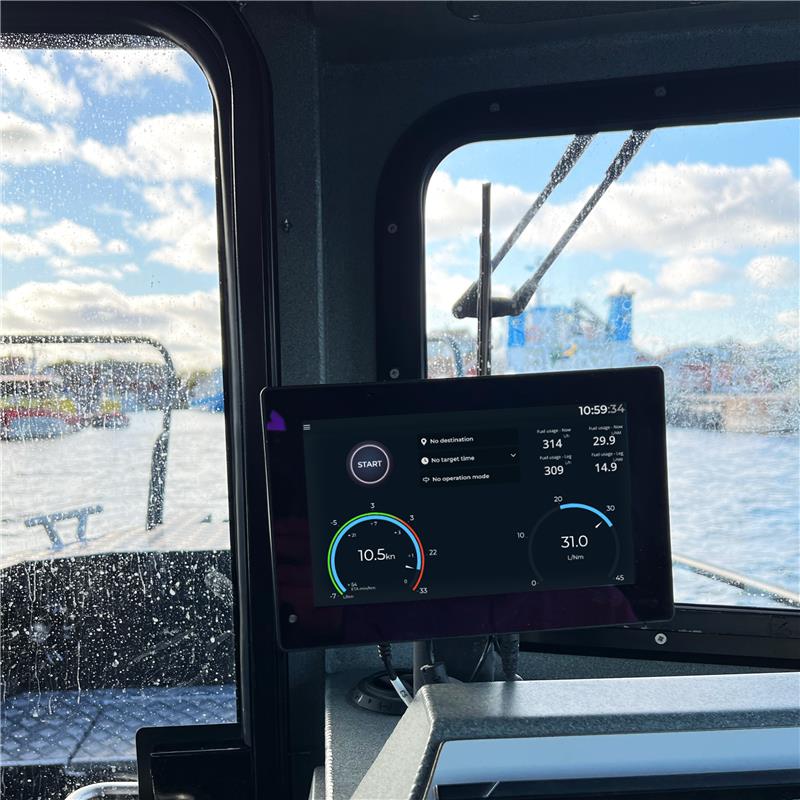
Onboard, crews interact with real-time dashboards that translate raw data into clear operational metrics.
These displays show:
- Speed and power usage
- Fuel-related estimates and emissions intensity indicators
- ETA visibility and schedule deviation indicators
- Operational modes and vessel status
Instead of relying on manual tracking or estimates, captains can make decisions based on live feedback, immediately seeing how changes in speed or maneuvering impact fuel use and performance.
Deviation Alerts for Early-Action Corrections
Real-time monitoring is most valuable when it highlights inefficiencies before they become costly. It provides targeted deviation alerts, including:
- Speed above optimal efficiency profiles
- RPM operating outside recommended ranges
- Unexpected fuel-estimation deviations
- Abnormal engine-load patterns
These alerts guide crews in adjusting operations quickly and maintaining consistent efficiency, even in changing conditions.
Historical Insights for Shore Teams
Every voyage is automatically stored in the cloud, allowing fleet managers to review operations long after the vessel has returned to port. Through the iHelm Cloud Dashboard, teams can:
- Compare performance across voyages and captains
- Analyze fuel and emissions trends over time
- Review event tags and operational modes
- Retrieve data for MRV and IMO DCS reporting
Historical insights turn day-to-day activity into long-term improvements, ensuring the fleet becomes more efficient with every voyage.
Centralized AI Decision Support Layer: Beyond Vessel-Level Visibility
Fuel-efficient operation becomes far more powerful when it moves from individual vessels to the entire fleet.
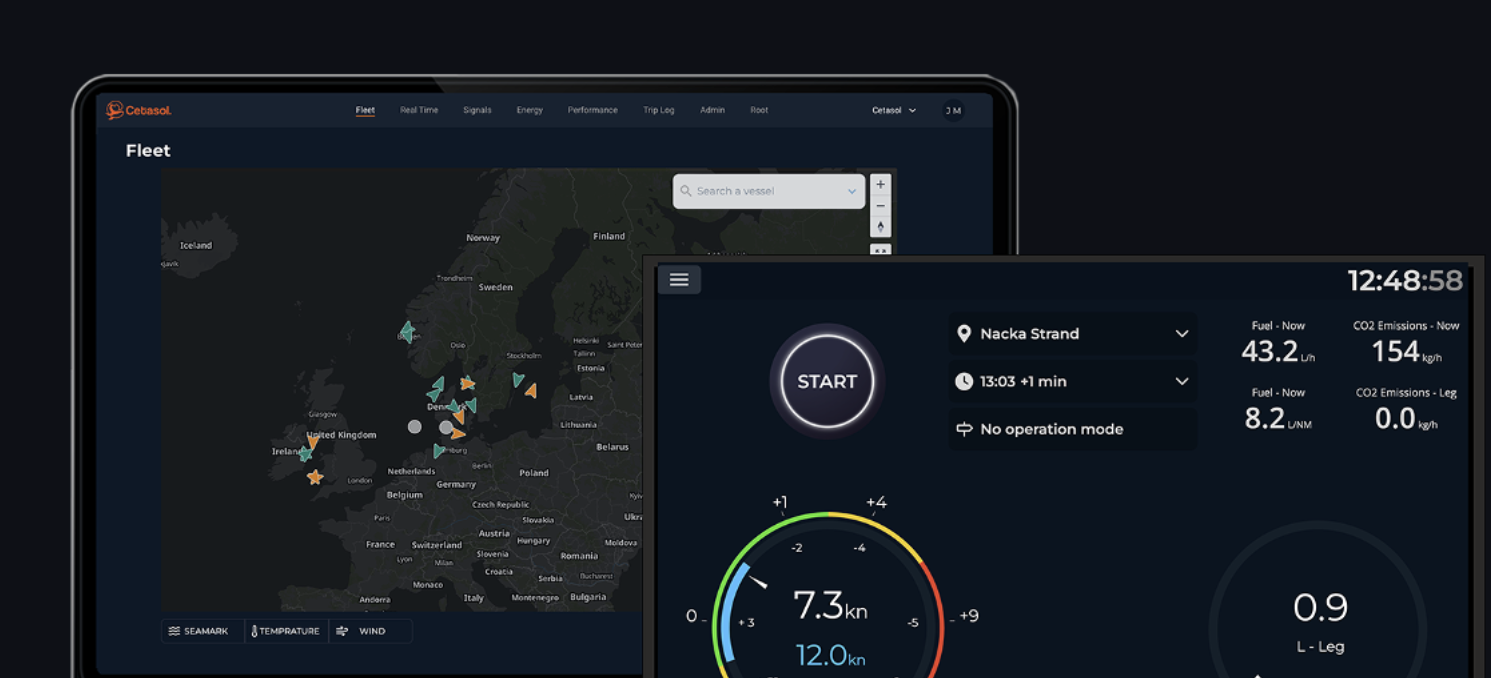
While traditional systems focus on single-vessel dashboards, iHelm supports this shift by providing real-time and historical data from each vessel in a shared cloud platform, giving shore teams a clearer operational picture across the fleet.
While each vessel runs its own onboard iHelm system, all processed data becomes available in the cloud.
Fleets can access:
- Real-time operational insights
- Historical voyage data
- Performance trends
- Reporting for MRV and IMO DCS
This consolidated access helps operators review vessels side by side, identify variations in performance, and understand how operational differences influence fuel consumption.
Because iHelm uses a data-driven operational model and adaptive AI, it continuously interprets patterns in how each vessel behaves in real operation. This allows it to:
- Help detect deviations from expected performance
- Identify vessels that are consuming more fuel than necessary
- Highlight where small improvements (e.g., a half-minute efficiency gain) lead to meaningful operational savings
- Show how changing sea conditions, maneuvers, or power usage affect fuel consumption
Instead of scanning multiple reports, operators receive a clear understanding of where improvements will produce the most value.
iHelm’s adaptive AI updates continuously as vessels operate. This ensures that:
- The operational model reflects real operating conditions, not theoretical design assumptions
- Recommendations evolve with crew behavior, weather, routes, and equipment changes
- Fuel-efficiency improvement opportunities become clearer over time
- Deviations are explained, including why they occurred and how to prevent them
This ongoing refinement makes optimization scalable across a diverse fleet, even when vessels of the same class behave differently.
By connecting real-time vessel data, data-driven operational performance modeling, and AI-driven insights, iHelm allows operators to oversee and evaluate fleet performance. This centralized approach supports:
- Lower total fuel consumption
- Reduced emissions across operations
- Better alignment between bridge crews and shore teams
- A more predictable and efficient operation overall
Predictive Maintenance: Prevent Instead of React
Predictive maintenance starts with continuous visibility into how a vessel’s machinery behaves in real time.
By monitoring engine signals, operators can spot early signs of inefficiency or abnormal behavior before they develop into larger issues.
Trend-based insights make it possible to plan maintenance proactively rather than reacting after a failure or relying solely on fixed service intervals.
Cetasol’s data-driven operational performance model strengthens this process by comparing expected behavior with real operational data. When the vessel’s behavior deviates from the modeled patterns, the system surfaces these differences for operator review, helping operators identify developing concerns, such as changes in estimated fuel behavior or changing load characteristics, while they are still manageable.
This approach reduces downtime, protects engine health, and supports more reliable operations overall.
Through the iHelm Cloud Dashboard, fleet teams can also review long-term trends across vessels, compare performance, and use historical data to refine maintenance planning.
Together, real-time insights and digital modeling shift maintenance from reactive troubleshooting to informed, proactive decision-making.
How Real-Time Fleet Analytics Support Emission & CII Goals
As regulations and sustainability expectations continue to evolve, maritime operators need clear, reliable data to understand their environmental impact and improve operational efficiency.
Real-time fleet analytics support this shift by providing continuous visibility into fuel consumption, operational patterns, and emissions across every voyage.
With CO₂ data captured and structured automatically, organizations can strengthen their corporate sustainability reporting and make more informed decisions about efficiency improvements.
Transparent fuel-consumption patterns also support SEEMP III planning, enabling operators to identify where small operational adjustments can reduce fuel intensity. When combined with voyage-level performance insights, fleets gain a clearer understanding of how operational behavior influences their Carbon Intensity Indicator (CII) rating.
Reducing unnecessary fuel use and refining operational profiles directly contributes to improved CII performance over time.
Real-time analytics also simplify compliance workflows. By automatically collecting and organizing operational and environmental data, such as virtual fuel estimation outputs based on operational signals, distance traveled, and emissions intensity, platforms like iHelm help fleet teams generate structured inputs for MRV and IMO DCS reporting.
This reduces manual workload, lowers the risk of human error, and ensures more consistent data quality across the fleet.
At the fleet level, centralized insight makes it easier to see which vessels or routes offer the greatest potential for emission reduction. Instead of relying on assumptions or static reports, operators can target optimization efforts where they will have the largest impact.
This combination of real-time visibility, historical comparison, and digital modeling provides a practical foundation for meeting sustainability commitments while improving day-to-day operational efficiency.
Final Thoughts: From Management to Mastery with iHelm
Maritime operations are shifting from manual oversight to real-time, data-driven decision-making. Fleets that continue relying on fragmented tools face delays, inefficiencies, and rising compliance pressure, while those adopting AI-supported systems gain clearer visibility, stronger efficiency, and more reliable long-term performance.
iHelm enables this shift by unifying real-time vessel data, operational performance modeling, and adaptive AI into one platform. It helps operators support fuel-efficient operation, streamline reporting, and strengthen their sustainability strategy, moving from reactive supervision to proactive, insight-driven fleet oversight.
Ready to bring real-time performance intelligence to your fleet? Book an iHelm demo today.