
Maritime AI: Why It's More Than Just Data Analytics
August 4, 2026
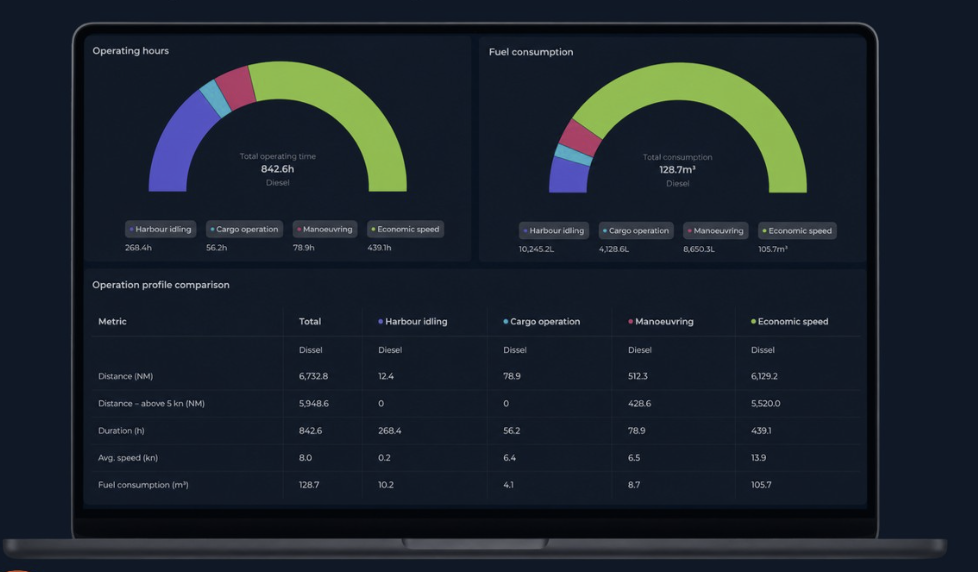
Maritime AI Is More Than Just Data Analytics
The maritime industry has never had access to more data than it does today.
Modern vessels generate thousands of data points every second, from engine performance and fuel consumption to weather conditions and navigational information. For fleet operators, this creates an incredible opportunity, but also a significant challenge.
More data doesn't automatically lead to better decisions.
Without the right tools to interpret and prioritize information, even the most advanced systems risk overwhelming users instead of supporting them.
This is where Maritime AI is changing the way fleets operate.
Rather than collecting even more information, the next generation of maritime technology focuses on turning existing data into meaningful insights that help crews and fleet managers make smarter decisions.
Throughout this article, we explore the key principles behind Maritime AI and how technologies like Digital Twins and intelligent decision support are shaping the future of fleet performance.
Maritime AI Starts with Context, Not More Data
Artificial Intelligence is often associated with automation or replacing human expertise. In reality, its greatest value in shipping lies somewhere else.
The role of Maritime AI isn't to make decisions for people.
It's to provide the right context, at the right time, so people can make better decisions themselves.
That starts by understanding the vessel.
Every ship behaves differently. Fuel consumption changes depending on weather, loading conditions, maintenance, routing, currents and countless operational factors.
Without context, data remains just numbers.
With context, it becomes actionable.
Digital Twins Create a Complete Picture
A Digital Twin is much more than a digital model of a vessel.
It continuously combines operational data from onboard systems with external information to create a dynamic representation of how the vessel is performing in real time.
Instead of reviewing isolated data points, operators gain a complete operational picture.
This makes it possible to identify trends, compare performance over time and understand why vessels behave differently under similar conditions.
The result isn't simply more visibility.
It's better decision-making.
🎥 Watch our CEO and Founder Ethan Faghani explain Digital Twins on LinkedIn:
https://www.linkedin.com/feed/update/urn:li:activity:7480146100247711744
The Biggest Challenge Isn't Data. It's Noise.
One of the biggest misconceptions surrounding digitalisation is that more data automatically creates more value.
In practice, the opposite is often true.
As more sensors and systems are added onboard, crews and fleet managers are presented with increasing amounts of information.
The challenge isn't collecting more data.
It's identifying which information actually matters.
When users spend valuable time searching through dashboards and reports, opportunities can easily be missed.
Instead of supporting better decisions, too much information creates unnecessary complexity.
Maritime AI helps solve this by filtering, prioritising and presenting information in a way that's easier to understand.
Instead of asking operators to process everything, the system highlights what deserves attention.
The future isn't about collecting more data. It's about understanding the right data.
AI Should Support Human Expertise
Artificial Intelligence is often described as something that replaces people.
In shipping, that isn't the goal.
Experienced crews possess years of operational knowledge that cannot simply be replaced by algorithms.
Instead, Maritime AI should work alongside human expertise.
Think about how the human brain naturally filters information.
Every second, it ignores thousands of details to help us focus on what matters most.
AI should work in a similar way.
Its purpose is not to generate additional information but to reduce unnecessary noise and surface the insights that help people act with greater confidence.
Rather than replacing experience, it strengthens it.
🎥 Watch Ethan explain the thinking behind CETA AI on LinkedIn:
(Add link once the video is published.)
Better Decisions Lead to Better Fleet Performance
Technology should never exist for its own sake.
The real value of Maritime AI is measured by the operational improvements it enables.
When fleet managers can identify inefficiencies earlier...
When crews receive clearer operational guidance...
When performance can be compared across vessels...
When fuel consumption can be better understood...
Decision-making becomes faster, more consistent and better informed.
Small improvements made consistently across an entire fleet can create significant long-term operational benefits.
That's where AI delivers its greatest value, not through automation alone, but by supporting smarter decisions every day.
🎥 Listen to Ethan explain this topic on LinkedIn:
https://www.linkedin.com/feed/update/urn:li:activity:7480870907704594432
Maritime AI Is About Better Decisions, Not Bigger Dashboards
The maritime industry doesn't need more dashboards.
It doesn't need more reports.
And it doesn't need more data for the sake of having more data.
What it needs are technologies that help people focus on the information that matters most.
That's exactly where Maritime AI is making a difference.
By combining Digital Twins, intelligent data analysis and human expertise, shipping companies can move beyond simply collecting information and begin making better operational decisions.
The future of fleet performance isn't built on bigger datasets.
It's built on better understanding.
Ready to Learn More?
At Cetasol, we develop intelligent decision support solutions that help shipping companies improve fuel efficiency, operational performance and sustainability through smarter use of data.
Whether you're exploring Digital Twins, AI-powered decision support or fleet optimisation, our goal remains the same:
Turning data into better decisions.
👉 Book a demo and discover how Cetasol helps fleets unlock the full value of their operational data.